12–27 September 2026
In My Own Time
The Memory of Light
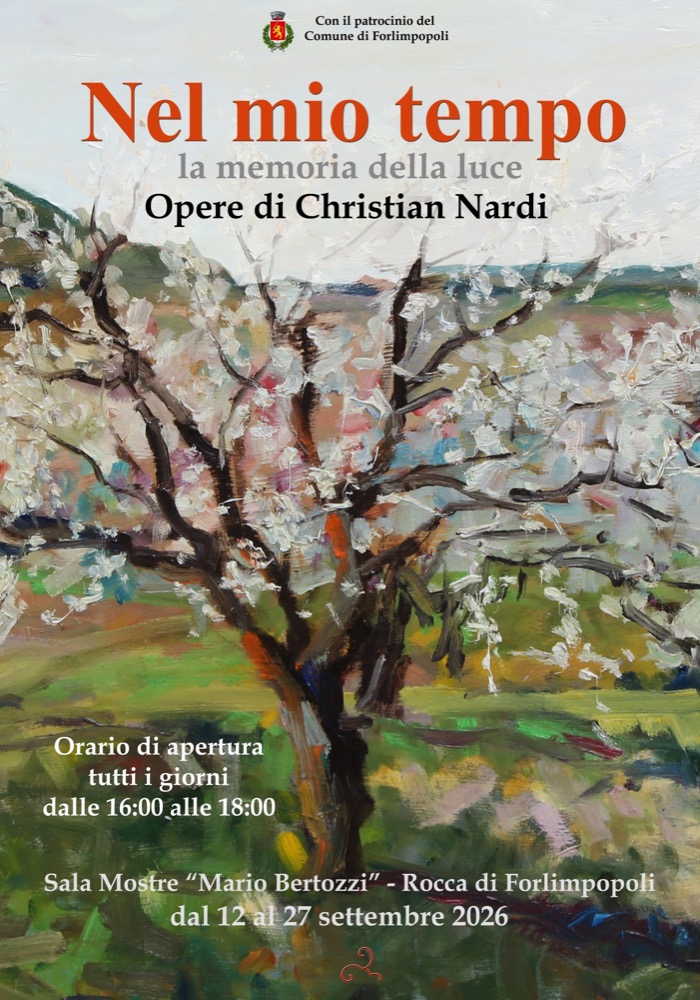
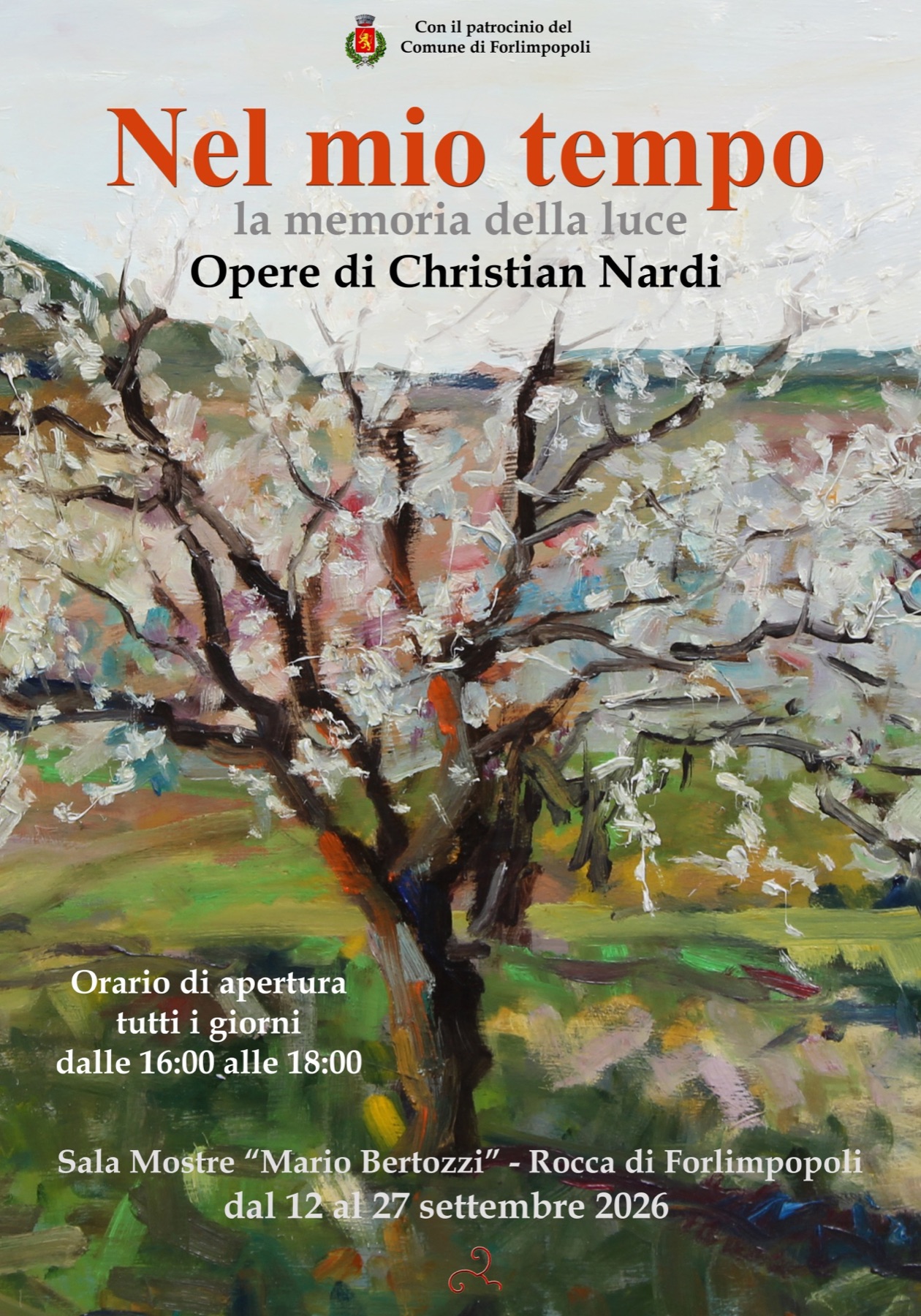
A solo exhibition gathering 51 paintings made between 2003 and 2026, organised by Francesco Giusti with a preface by Carla Agostini.
- Dates
- 12 – 27 September 2026
- Opening Saturday 12 September
- Hours
- 4:00 pm – 6:00 pm
- Every day
- Venue
- Rocca di Forlimpopoli
- “Mario Bertozzi” Hall, Forlimpopoli, Italy
- Works on view
- 51 paintings
- Five sections, over twenty years of work
Curatorial text
Painting, when it is born of a sincere necessity, is not charged with reproducing reality: it seizes spaces in which to find oneself and captures them in order to make them its own. Christian Nardi’s is a personal world. His landscapes are like inner mirrors, and the brushstrokes on the canvases speak because they go beyond the silence of their subjects, inviting us into the painter’s sensibility. This exhibition is a visual diary of feeling, told in a sequence that does not follow an academic chronology but adapts to the artist’s own path, crossing more than twenty years of research. The works gathered here belong to different seasons and moments of Nardi’s life, yet they share the same need: to give nature and the human figure a space in which to be noticed again and reworked in the light of a new meaning — his meaning.
Behind every canvas there is a time Nardi took for himself, subtracted from the frantic rhythms of everyday life: a time to stop, to breathe, to look calmly and understand what we normally pass through in a hurry or distractedly. In this recovered time, painting became over the years a way of regenerating himself, before being a craft or a declared vocation.
In this carved-out space, time stops being filled like a duty or something that must necessarily follow a logic, and turns into a light ready to bring spaces and moments into relief. Colour settles into the geometry of golden fields, reflects on the damp quays of harbours, hides behind a field of paint that seems born of instinct: each painting fixes a fragment of lived experience and, at the same time, leaves it free to vibrate, like an echo that keeps resonating in the mind of the viewer. Painting thus becomes a meditation on the persistence of beauty and on its capacity to return in ever different, yet always necessary, forms. Without that gaze there would be no life.
The five sections that make up the itinerary — Romagna, The Time of Awakening, The Time of Return, The Time of Silence and The Time of the Other — are as many stages of this inner journey: the place of childhood, the rebirth of nature, landfall at the home sea, the suspension of snow, the encounter with the human figure. Each tells a different way of taking one’s own time, of stopping to look instead of being dragged along by the present.
Preface
“In my own time” struck me already in its title
“Nel mio tempo” — In my own time — struck me already in its title. In: right inside. My: nobody else’s. Time: a strange place, time, not physical yet utterly concrete, marking out the space in which one is, and wants to be.
I have known Christian since before he became so passionate and tenacious in his painting, so present in pursuing what he would become. I know, and I can bear witness to, his first steps, the overflowing creativity that not even the frames could contain.
I know his study: never theoretical, always tested and adapted to himself, to his own way of looking — something you can recognise and trace above all by observing the paintings in chronological order. It is a conscious crescendo around the subject, because one fact is absolutely recognisable: Christian looks, and he knows how to see.
This exhibition also has a subtitle: “The Memory of Light”.
Memory is a very powerful word. It does not concern only the facts that stay inside us; it concerns what shapes a person — all those encounters with people, places and situations that make you feel alive. Why, then, the memory of light? Because light, the light Christian knows how to paint, is capable of astonishing during that silent observation we reserve for a work of art. It can be violet or indigo as in a winter sky; it can be in the unripe green brushstrokes of certain meadows, in the brilliant blues of water and clear skies, in the pink of flowers that impose themselves like promises. And it can be — and here it is truly moving — in the colours of Maternità, luminous with the intense bond between a nursing mother and her child, and in the shadowed areas from which the waiting figure emerges out of darkness in Attesa.
Every artist, and Christian is no exception, studies — and studies a great deal — the great masters. We can recognise some Impressionist brushwork, some fields of colour recalling Cézanne, some Turner-like gradations. But this too is a point in favour of the exhibition: the masters are present because nobody makes themselves alone. No artist is solitary: bonds are formed, encounters happen, and dialogue and personal study shape a personality. We have an example of this in the works Christian has chosen to share with us all.
Only one thing remains to be said: thank you, Christian.
Carla Agostini
The venue
The Rocca of Forlimpopoli
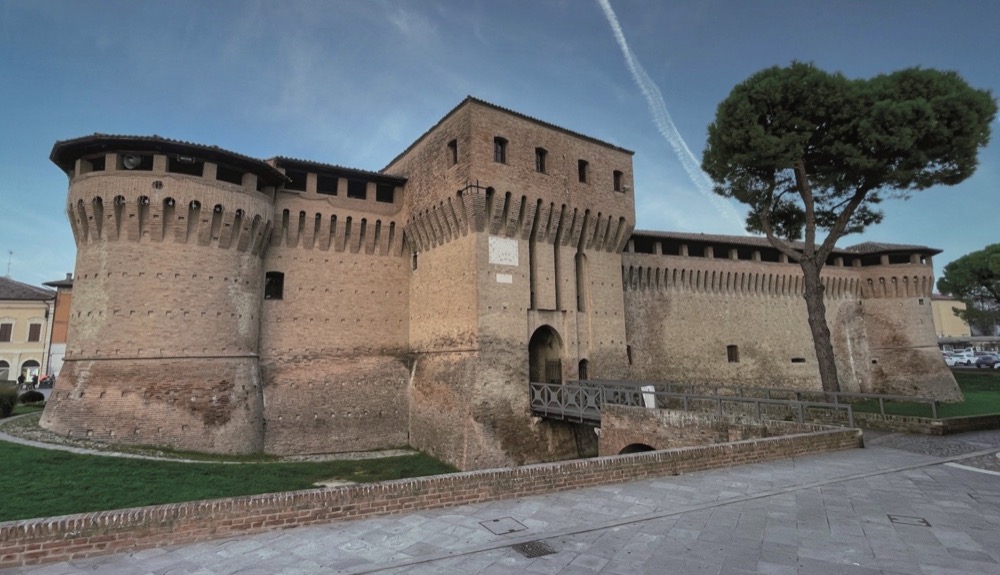
Immersed in the evocative atmosphere of Romagna, the Rocca of Forlimpopoli stands as an imposing testimony to the Renaissance military past, able to enchant the eyes and spirits of those who visit it. Skilfully built around 1361 on the ruins of the ancient cathedral — destroyed by the papal troops of Cardinal Albornoz — the fortress has crossed centuries of history as a silent witness to different eras and dominations.
Reinforced and enlarged over the centuries by the Ordelaffi, lords of the city, the Rocca appears today in all its majestic solidity, characterised by four powerful corner towers and a curtain wall overlooking a wide moat, evidence of its strategic role of defence and territorial control. Its mighty walls tell stories of rule and power, spanning the periods under the Riario-Sforza, Cesare Borgia, the Rangoni and the Zampeschi families.
At the end of the eighteenth century the Napoleonic army requisitioned it, marking a further chapter in the long life of the fortress. Today the building houses the Town Hall, the Archaeological Museum, the Verdi cinema-theatre and the “Mario Bertozzi” exhibition hall, the venue of this exhibition.
Every stone, every corner of this ancient structure breathes history and culture, inviting visitors to explore its depths and to be captivated by the timeless beauty that only history and art can evoke.
Information
Planning your visit
Where
“Mario Bertozzi” Exhibition Hall — Rocca di Forlimpopoli
Piazza Fratti — 47034 Forlimpopoli (FC), Italy
When
12–27 September 2026
Every day, 4:00 pm – 6:00 pm
Credits
Organised by Francesco Giusti. Preface by Carla Agostini. Under the patronage of the Municipality of Forlimpopoli.
Contact
For information on the works, guided visits or press enquiries.
Acknowledgements
I wish to express my deep gratitude to all those who, over these twenty years and more, have believed in my research, offering me their attention, their dialogue and the space to let my images vibrate.
My most sincere thanks go to those who curated this catalogue and were able to translate into words the silent urgency of my painting, offering a precious key for entering my time and my memory of light.
A thought of immense gratitude and affection goes to Maestro Michele Pagano, a brotherly friend and generous guide: to him I owe the beginning of this journey and the awareness that I could look at the world through the freedom of colour.
I thank the friends, artists and collectors who shared with me the magic of the years at the Caffè in Cesena, a place that was sap, home and school of life, and where I understood that art is above all an act of deep sharing.
A special thank you goes to my family, who every day, with patience and discretion, walk beside me, supporting my silences, my hours spent before the canvas, and that constant need to search for the light that dwells inside things.
To all of you, and to anyone who stops even for an instant to look at these works, goes my most sincere gratitude.
Christian Nardi